
December 9, 2025
Strengthening collaboration and innovation in freight wagon braking and adhesion

The Freight Safe Programme welcomed experts from across the rail industry to a Freight Braking and Adhesion Research Group (FBARG) seminar, held in Derby on 3rd December.
Established in late 2024, FBARG co-ordinates and oversees research on freight train braking and adhesion performance, and supports three major research projects delivered under the Wagon Condition Programme (WCP) and governed by the Freight Safe Programme (FSP) board.
Delivered in partnership with RSSB, the event brought together a strong attendance of representatives from across the sector, including freight operating companies, Entities in Charge of Maintenance, Original Equipment Manufacturers, infrastructure managers, the Office of Rail and Road, the Rail Accident Investigation Branch, and academia.
Co-hosted by Neil Ovenden, Chair of the Wagon Condition Programme’s FBARG group, and Tim Shakerley, the WCP Programme lead, the seminar offered a comprehensive overview of both completed and ongoing research in managing braking performance in low adhesion, understanding longitudinal compressive forces and the rate at which wheel flats can form under varying braking and adhesion conditions – all of which have the potential to cause derailments.
The morning sessions focused on completed research and featured three presentations. Robert Morley of Mott MacDonald shared findings on the above rail-related factors contributing to wheel flats in freight vehicles, supported by detailed modelling and analysis. This was followed by Julian Stow from the University of Huddersfield, who presented work modelling the underlying conditions that can lead to wheel flats in rail freight vehicles.
Mark Thompson, of Thompson Technical Services, then provided a deep analysis of causal events leading to wheel damage in rail freight wagons. Together, these insights offered a robust understanding of the causes of wheel damage and set the foundation for targeted improvements in braking performance.
In the afternoon, attention turned to ongoing work programme studies. Adam Twigg and Daniel Jones, from Serco, examined the factors impacting freight braking in low adhesion, followed by Paul Molyneux-Berry from the University of Huddersfield, who outlined work to better understand longitudinal compressive forces in rail freight. Both sessions sparked lively discussion through dedicated Q&As led by Tim Shakerley.
The seminar highlighted the importance of continued collaboration to enhance performance, build confidence, and support long-term growth in the rail freight sector. Participants acknowledged the vital role of data in understanding industry trends and were invited to identify any knowledge gaps and areas where further research by FBARG could add value.
Expert speakers offered a comprehensive overview of both completed and ongoing research undertaken by FBARG
Commenting on the future direction of the programme, Tim Shakerley said:
“I am looking forward to seeing the implementation of the outputs of FBARG’s work over the next few months and years.
“The next phase of research within the FBARG Programme includes investigative static brake testing to unlock new learning about how train lengthening impacts braking and low adhesion performance – as well as how train compressive forces may build – and brake force modelling, helping us understand the impacts of different brake system design, maintenance and their inter-train compatibility.”
Neil Ovenden, adds:
“We are very grateful for the valuable discussion, audience engagement and active participation from those that attended. We gained industry support for the direction of future research and so we are now confident that we are tackling the priorities of the industry with continued stakeholder support.
“Helping to address the challenges of operating rail freight in all conditions of adhesion and reducing the propensity of wheel flats will continue to enhance rail freight’s performance and safety credentials in pursuit of our growth agenda.
The event concluded with reflections from David Golding, Safety and Sustainability Director at GBRF and member of the FSP Board, who said:
“Today’s event demonstrated the rail freight industry’s commitment to understanding braking and adhesion dynamics, By harnessing this collective knowledge we can drive continuous improvements for the benefit of all.
“Companies and organisations working together in this way demonstrates the industry’s maturity in collaborating to further enhance the safety and performance of the entire rail freight sector, proving rail’s reliability as a preferred transport for customers across the country.”
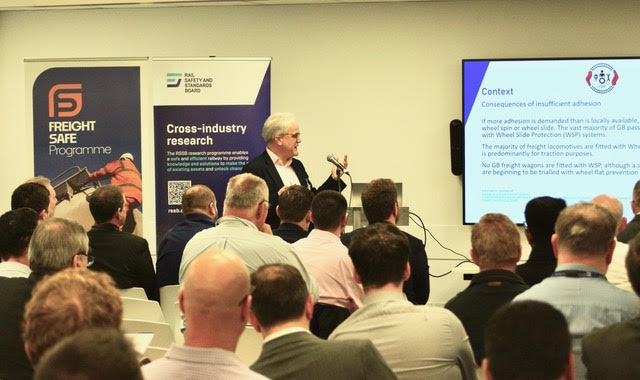
The FBARG seminar shared findings on the underlying conditions that can lead to wheel flats in rail freight vehicles